
Welcome to the green heart of French royalty! If you are looking for an experience that blends history, art, and nature into a single, unforgettable visit, then the Gardens of Versailles is the place for you.
A true jewel in the crown of the Palace of Versailles, these gardens are not only a display of extraordinary scenic beauty-they are also silent witnesses to historical intrigue and garden art that marked an era.
In our journey through the Garden of Versailles, I will take you on a tour of how this vast park was shaped by the hands of artists and gardeners in the service of King Louis XIV, transforming it into a stage of timeless luxury and magnificence. We will talk about the water features, the sculptures that adorn every corner, and the secrets that each pathway seems to whisper as visitors pass by.
Not only history and art: I will also provide you with all the practical information you need to best organize your visit: where to buy tickets, the best times to enjoy the park, and answers to the most frequently asked questions that every visitor asks before arriving at the gates of this extraordinary world heritage site.
Are you ready to be enchanted? Continue reading and get ready for a unique experience in the gardens of the Palace of Versailles.
But before you dive further into the reading, stop for a moment! Have you already thought about how to make your visit as smooth and enjoyable as possible? Avoid the long lines and secure instant access by purchasing your skip-the-line ticket now. With just one click, you can guarantee yourself an unforgettable experience, without unnecessary waiting, to fully enjoy every minute spent in this enchanted place. Don’t miss the opportunity to experience the magic of Versailles to the fullest: buy your ticket now and get ready to discover one of the wonders of the modern world without interruption.
Palace of Versailles: Entrance Ticket + Gardens and Trianon Estate
Buy online. Choose your preferred time. Visit the Palace of Versailles and the halls of the Palace, access the beautiful gardens and the stunning Trianon Estate.
You can cancel for free up to the day before your visit.
Table of Contents
Gardens of Versailles: history and description
The gardens of Versailles are not merely a complement to the majestic Palace of Versailles, they are, instead, one of the most sublime creations in the field of Baroque gardening, a veritable outdoor museum that embodies the grandeur and ambition of an era.
Designed and perfected over many years, these gardens are a perfect example of how landscape art can reflect and enhance the power and culture of a ruler and an entire nation.
In the next journey through words and images, we will explore the birth and evolution of the Gardens of Versailles, admire their aesthetic wonders, and discover how they have been used over the centuries to entertain, impress, and exercise power.
The construction of the Gardens of Versailles

Photo by Armand Khoury on Unsplash
The birth of the gardens of Versailles is a story of ambition and vision, beginning during the reign of Louis XIV, known as the Sun King. Construction of the gardens began in 1661 and was part of a project to expand the palace, which Louis XIV wanted to turn into a symbol of his absolute power and control over nature itself.
The king entrusted the task of realizing this vision to André Le Nôtre, one of the most famous gardeners of his time, who had already demonstrated his talent by working on other major projects such as the Tuileries Gardens in Paris. Le Nôtre designed the gardens of Versailles with a geometric and symmetrical layout, characteristic of the French formal style, which aimed to impose order and structure on natural disorder.
One of the most revolutionary aspects of Le Nôtre’s design was the use of a visual perspective that extended the view from inside the palace to the horizon, creating a sense of infinity and dominance over the surroundings. The garden was organized with avenues radiating out from the palace like the rays of the sun, the symbol of the King, and was decorated with a series of fountains, statues and parterres.
The creation of these gardens was not an easy or quick undertaking. In fact, it required the rearrangement of the land, the import of large amounts of soil, the construction of a complex system of hydraulics to feed the fountains, and the planting of thousands of trees. It took decades to complete the entire project, which continued to expand and evolve even after Le Nôtre’s death, under the guidance of other architects and gardeners.
The gardens of Versailles were designed not only to amaze visitors with their beauty and technical innovation, but also to serve as a majestic backdrop for the festivities, celebrations and daily activities of the Versailles court, thus reflecting the grandeur of Louis XIV’s reign.
Through their design and function, the gardens became a potent symbol of the art of ruling, designed to impress both subjects and foreign guests and to embody the ideal of perfection and control that the Sun King so desired to display to the world.
Delights and wonders of the Gardens of the Palace
The gardens of Versailles are a veritable display of grandeur and refinement, where every landscape element is designed to enchant and amaze. A complex of artistic and engineering masterpieces combine to create an environment of sovereign beauty.
As we explore the different aspects that make up the wonders of the gardens, we will dwell on the parterres, groves, fountains, promenades, and statues, all of which contribute to making this place unique in the world.
The parterres of the Gardens of Versailles
In the gardens of Versailles, the parterres represent the pinnacle of Baroque gardening art. At the foot of the Palace, on the garden side, are three large parterres: the North Parterre, the South Parterre, and the Water Parterre. The latter, featuring two large rectangular pools, is particularly noted for how it reflects the sun’s rays, illuminating the exterior facade of the Mirror Gallery.
The Water Parterre

ID 197665558 @ UlyssePixel | Dreamstime.com
Le Nôtre, the celebrated landscape architect, considered light as much a decorative element as vegetation. His creations in the gardens of Versailles are a perfect balance of light and shadow, where water and light come together to create a unique visual spectacle.
The two large pools of the Water Parterre were not completed in their final appearance until 1685, after several modifications, under the direction of Charles Le Brun, who also designed the sculptural decorations. Each basin is framed by four bronze figures representing French rivers: the Loire and the Loiret, the Rhône and the Saône, the Seine and the Marne, the Garonne and the Dordogne, works by Thomas Regnaudin, Jean-Baptiste Tuby, Étienne Le Hongre and Antoine Coysevox, respectively.
Completing the decoration are four nymphs and four groups of children located on the long edges of the basins.
The northern parterre

ID 197897005 @ UlyssePixel | Dreamstime.com
Accessible via a flight of steps flanked by two bronze statues, the North Parterre is divided into two large sections, each characterized by a circular pool in the center.
This parterre leads northward to the Pyramid Fountain, created by sculptor François Girardon to a design by Charles Le Brun.
This fountain, placed in the center of the pool, took three years to complete and consists of three tiers of lead basins supported by tritons, dolphins and shrimp, also made of lead.
The south parterre
Also known as the Jardin des Fleurs (Flower Garden), the South Parterre attracts the eye to a balustrade from which the Orangerie Parterre can be seen from above.
The central section of the parterre is reached by a few steps, framed by two bronze statues of sphinxes ridden by Amoris, placed here in 1685 but originally located on either side of the top of the Grand Staircase at the Parterre de Latona.
The Parterre of Latona

ID 197665582 @ UlyssePixel | Dreamstime.com
Nearly 3.5 hectares in size and located in the heart of the Gardens of Versailles, the Parterre de Latona was designed by André Le Nôtre in the mid-1760s, during the first phase of the embellishment work ordered by Louis XIV.
After the Revolution, this space was transformed into a simple lawn. The floral decorations were not added until the late 19th century and remained until 2015, when the parterre was restored to its original form.
Palace of Versailles: Entrance ticket + Gardens and Trianon Estate
Purchase online. Choose your preferred time. Visit the Palace of Versailles and the halls of the Palace, access the beautiful gardens and the stunning Trianon Estate.
You can cancel for free up to the day before your visit.
The Orangery at the Gardens of Versailles
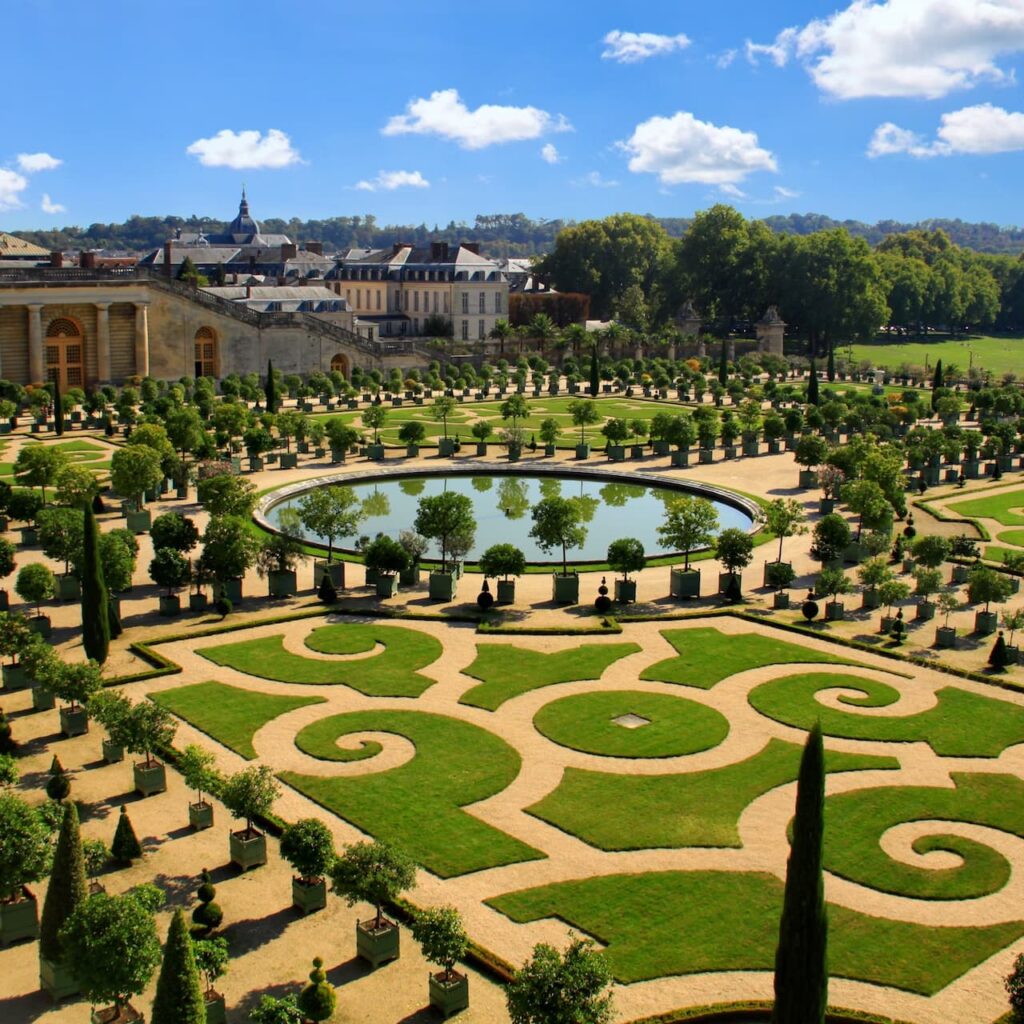
Located just below the Palace, the Orangerie at Versailles is one of Jules Hardouin-Mansart‘s most spectacular achievements, a true masterpiece that enhances his talent as a great architect. Its pure lines, height and grandeur are not only a feast for the eyes, but also an ideal refuge for an extraordinary collection of plants.
Architecture and strategic location
The original Orangerie was built in 1663 to the design of Louis Le Vau and placed in a prime location protected from cold winds, namely just below the Parterre Sud.
About two decades later, Hardouin-Mansart greatly expanded the design, doubling its length and width. This transformation created an imposing structure with a central gallery that stretches more than 150 meters and features a vaulted ceiling 13 meters high. The side galleries are located under the monumental Hundred Steps stairs.
The walls, which are 4-5 meters thick, the double windows and the southern orientation allow for a winter temperature that never falls below 5°C, an ideal condition for plant conservation during the cold months.
A botanical collection of inestimable value

ID 322603745 @ Mikhail Ognev | Dreamstime.com
During the winter, the Orangery is home to orange trees from Portugal, Spain and Italy, as well as lemons, oleanders, palms and pomegranates, some of which are over 100 years old. As summer arrives, these plants are moved outdoors, elegantly distributed on the Orangery’s parterre, creating a natural spectacle of rare beauty.
The Orangery’s collection of citrus trees began thanks to the ambitious initiative of Louis XIV, who collected all the orange trees from royal residences and purchased large numbers from Italy, Spain and Portugal.
It was considered a sign of good manners for courtiers to pay homage to the king by offering him their orange trees. These were transported with such haste, even in the middle of winter, that many did not survive the journey.
However, accidents aside, it was not long before the Orangery at Versailles boasted the largest collection of citrus trees in Europe.
The Groves of Versailles
The gardens of Versailles, designed and cared for by the eminent gardener and architect André Le Nôtre, have hosted numerous court festivities over the years and have been subject to constant modification. Among the lesser-known and more fascinating wonders of these vast gardens are the groves, small enchanted gardens, often hidden behind walls of greenery or trellises and reached by discreet paths.
Originally created during the reign of Louis XIV, there were fifteen of these groves, each with its own decorative theme that ranged from various shapes and decorations.
The Marquis de Dangeau, a contemporary of Louis XIV, described them as “framed fountains,” places adorned with fountains, vases, and statues that introduced elements of surprise or fantasy within the larger garden, serving as veritable outdoor lounges.
Despite the rigid regularity of the general design of the gardens, the groves offered a delightful variety of scenery and never failed to surprise visitors with their diversity. Many of these groves were designed by André Le Nôtre, but some underwent modifications under the direction of Jules Hardouin-Mansart.
However, expensive and difficult maintenance led to the rapid deterioration of some of them, which disappeared during the 18th century. The Labyrinth, one of the most famous, was destroyed when the gardens were renovated in 1775-1776. Others, such as the Baths of Apollo, were transformed in the Anglo-Chinese style much in vogue during the reign of Louis XVI and Marie Antoinette. In the 19th century, the Royal Island was filled in and transformed into the King’s Garden, planted with rare and exotic trees.
This chapter will explore the southern and northern groves of Versailles, revealing how these secret gardens have continued to enchant visitors through the centuries, offering a haven of beauty and tranquility away from the opulence of the busier garden areas.
The Southern Groves of Versailles
The Queen’s Grove
Once home to the famous Labyrinth, adorned with thirty-nine painted lead fountains depicting animals from Aesop’s fables, the Queen’s Grove was completely transformed in 1775-1776.
Originally known as the Grove of Venus, today this garden features a simple but elegant layout designed to highlight at its center a new type of tree recently introduced in France: the Virginia tulip tree.
The current sculptural decoration was added at the end of the 19th century, and the grove has been restored thanks to the support of numerous companies, foundations, and institutions, as well as private individuals, becoming accessible during the days of the Fountain Shows and Musical Gardens.
The Grove of the Ballroom

ID 188592247 @ Michael Mulkens | Dreamstime.com
Thelast of the groves created by Le Nôtre, the Ballroom Grove saw its construction work begin in 1680; it was not completed until five years later with a grand banquet to celebrate its inauguration.
Conceived as an amphitheater of greenery, the original design included a small island surrounded by a two-level canal, reached by four small bridges. In 1707, Jules Hardouin-Mansart eliminated the island, while Le Nôtre took advantage of the slope of the land to create a large waterfall-the only one in Versailles-that occupied the entire eastern side of the amphitheater. Decorated with marble slabs, windmills and shells, this waterfall was surrounded by tiers adorned with boxwood hedges.
The Girandole Grove
The Girandole Grove, along with the corresponding Dolphin Grove to the north, was one of the first to be designed by Le Nôtre in 1663. Each grove had a central clearing with a fountain.
In 1682, the edges of the pool of the Pinwheel Grove were decorated with a pattern of reeds, from which gushed jets of water that converged toward the center, where a jet of water sprang from a basket of realistically painted flowers. The shape of the jet, which resembled that of a pinwheel, gave its name to both the pool and the grove. The latter, like the Dolphin Grove, was eliminated during the reorganization of the garden in 1775-1776, but both were restored in 2000.
The Colonnade Grove

ID 55338254 @ Tanner Connely | Dreamstime.com
Begun in 1685 by Jules Hardouin-Mansart, the Colonnade replaced the Spring Grove created by Le Nôtre in 1679. This circular structure, consisting of thirty-two Ionic columns and as many arches, is a masterpiece of architecture.
The columns alternated deep blue marble, purple breccia, and Languedoc marble, with sculptural decoration by renowned artists depicting cherubs and marine or rustic deities.

ID 173515042 @ Morbilli | Dreamstime.com
The Chestnut Grove
The Chestnut Grove was designed by Jules Hardouin-Mansart in 1704, replacing an earlier grove designed by Le Nôtre. Originally, this space housed a remarkable collection of ancient sculptures and reproductions, placed on pedestals along the canal surrounding the central section. The ends of this open-air museum were embellished with fountains.
Hardouin-Mansart transformed the grove by removing the fountains and central island and replacing them with two rows of chestnut trees.
The Northern Groves of Versailles
Grove of the Domes

ID 292018946 @ Nicolae Ovidiu Gavrilovici | Dreamstime.com
Originally created by André Le Nôtre in 1675, the Grove of Domes has evolved through multiple reworkings that have changed its appearance and name over the centuries.
Characterized by an amphitheatrical design, the heart of the grove is dominated by a hexagonal pool surrounded by a gilded metal balustrade, from which jets of water gush from eighteen columns. The statue of Fame, located in the center of the pool, originally gave the grove its name.
Substantial modifications were introduced by Jules Hardouin-Mansart between 1677 and 1681, with the addition of two pavilions adorned with domes. This structure housed important sculptural groups from the demolished Cave of Thetis, including“Apollo served by Nymphs.”
The transformations reached a climax in 1708 with the replacement of the central fountain with a white marble basin supported by dolphins, creating a work of art of refined elegance and complexity.
Grove of Enceladus

ID 188850224 @ Michael Mulkens | Dreamstime.com
Enceladus Grove is famous for its spectacular fountain, by Gaspard Marsy, depicting the giant Enceladus half-buried under rocks, with a powerful jet of water exploding from its mouth like a cry of pain.
Created between 1675 and 1677, the grove underwent major alterations in 1706 by Jules Hardouin-Mansart, who opened up the space by transforming it into a crossroads of paths, removing the small pools and trellis structures.
A thorough restoration program between 1992 and 1998 restored the grove to its original appearance, reconnecting visitors with this intense mythological and artistic representation.
Obelisk Grove

ID 314363546 @ Philippehalle | Dreamstime.com
Originally known as the Banquet Grove, the Obelisk Grove was radically transformed by Jules Hardouin-Mansart in 1705-1706.
The architect devised a large rectangular pool on two levels, with water jets forming a liquid obelisk that cascades down into the lower basin via four steps. This innovative design not only demonstrates the technical advancement of water features at Versailles, but also underscores the continuing quest for spectacularity and majesty in the palace gardens.
Grove of the Baths of Apollo

ID 197727682 @ Michael Mulkens | Dreamstime.com
The Grove of the Baths of Apollo, located in the same area as the former picturesque Grove of the Marshes created by Le Nôtre, was completely reworked under the reign of Louis XVI between 1778 and 1781.
The painter Hubert Robert designed an English-style garden with a lake in the center, dominated by a large artificial rock with waterfalls and a grotto. This transformation created a romantic and immersive environment, further enhanced by statues of Apollo and the Horses of the Sun, thus reintegrating sculptural art into the natural setting.

ID 38745701 @ Philippehalle | Dreamstime.com
Star Grove
The Star Grove, with its original design inspired by the shape of a star, was one of the earliest examples of the creative use of geometric paths and layouts in the gardens of Versailles.
Created in 1666, the grove has undergone significant transformations over the centuries, including the removal of the central pool in the 18th century. Recently, a restoration program has restored some of the elements of Le Nôtre’s original design, keeping the heart of the grove as a meadow that invites visitors to reflect on the site’s long and varied history.
Grove of the Water Theater

ID 193374566 @ UlyssePixel | Dreamstime.com
The Water Theater, designed between 1671 and 1674, was a place of extraordinary hydraulic ingenuity, intended to showcase the most advanced technologies of the time.
Conceived as an open-air theater, this space was divided into a spectator area and a “stage” where highly complex water games took place.
However, due to high maintenance costs, the Water Theater was transformed into the more modest Green Ring Grove at the end of the 18th century.
In 2009, the Palace of Versailles held an international competition for its restoration. The project proposed by landscape architect Louis Benech and artist Jean-Michel Othoniel won. The restored work was inaugurated in 2015 and demonstrates a perfect blend of contemporary art and history.
Gilded Children’s Pool
Located near the Water Theater Grove, the Gilded Children’s Pool was installed by Jules Hardouin-Mansart in 1709. This small oval basin features at its center a group of eight lead cherubs, sculpted by Jean Hardy in 1704, originally intended for the parks of Marly and transferred to Versailles in 1709.
The pool was restored in 2016 with the support of the BNP Paribas Foundation and the technical expertise of D’Huart Industrie.
Grove of the Three Fountains

ID 157146895 @ Mistervlad | Dreamstime.com
Created in 1677 by Le Nôtre, the Grove of the Three Fountains is one of the king’s most personal achievements, as evidenced by an ancient map that refers to it as “the King’s idea.”
Arranged along a natural slope, the grove has three levels, each connected by waterfalls, with fountains projecting jets of water creating different symbolic designs: afleur-de-lys (lily) in the lower basin, a water vault in the middle basin, and a water column formed by one hundred and forty jets in the upper basin.
Restored in 2005, the grove has recovered the original design and water effects desired by the ruler.
Arc de Triomphe grove

ID 37799904 @ Philippehalle | Dreamstime.com
The Arc de Triomphe Grove, initially set by Le Nôtre between 1677 and 1684, has mainly preserved the lower part near the Neptune Fountain.
Accessible from the high terrace, the gilded metal Arc de Triomphe sprayed water from numerous jets and cascades. On either side, water channels and gilded metal pyramids added to the splendor of the place.
The Fountain of Victorious France, created by sculptors Coysevox, Tuby and Prou, added further significance to the whole grove by celebrating the king’s military victories.


Palace of Versailles: Entrance Ticket + Gardens and Trianon Estate
Purchase online. Choose your preferred time. Visit the Palace of Versailles and the halls of the Palace, access the beautiful gardens and the stunning Trianon Estate.
You can cancel for free up to the day before your visit.
The Fountains of the Gardens of Versailles
The Gardens of Versailles represent a pinnacle of French gardening art, a place where man’s control over nature achieves unprecedented majesty. A key element of this dominance is the use of water, which manifests itself in a variety of spectacular forms: from waterfalls in the groves to water jets in the fountains, to tranquil water surfaces reflecting sky and sun in the Parterre d’Acqua or Grand Canal.
These water features are essential not only for their aesthetic beauty, but also for their role in the symbolism and representation of royal power.
The four fountains of the seasons

ID 133085663 @ Galvani Raffaella | Dreamstime.com
At the center of the main intersection of the avenues, which run parallel or perpendicular to the Royal Way, are four fountains built in the 1770s, each dedicated to a season of the year.
Taking in the end of the Parterre de Latona and the entrance to the Royal Way, it is possible to admire all four fountains at once, a symmetrical and beautifully balanced view.
- The Spring Fountain or Flora Fountain (1674) celebrates the awakening and renewal of nature, adorned with sculptures representing Flora, the goddess of flowers and spring.
- The Summer Fountain or Fountain of Ceres (1673) pays homage to abundance and fertility with figures of Ceres, the goddess of agriculture.
- The Autumn Fountain or Fountain of Bacchus (1674) symbolizes harvest and pleasure, with sculptures of Bacchus, the god of wine.
- The Winter Fountain or Fountain of Saturn (1677) represents the sleep and rest of nature, featuring the figure of Saturn, the god of time and eternity.
Animal Fighting Fountains

ID 188115 @ Jorgefelix | Dreamstime.com
To thewest of the Water Parterre, on either side of the central axis, stand two fountains designed by Jules Hardouin-Mansart in 1687. These fountains show animals in combat with impressive realism.
The Diana Fountain or Evening Fountain, depicts a lion felling a wolf and a lion felling a boar, works by Cornelius Van Cleve and Jean Raon.
The Fountain of Dawn depicts a tiger felling a bear and a hound felling a deer, sculptures by Jacques Houzeau.
Dragon Fountain

ID 237392047 @ Denise Serra | Dreamstime.com
The Water Trail ends in a semicircle near the Dragon Fountain, a work depicting the mythological episode of Apollo killing the serpent Python. Its majestic water jet can reach a height of 27 meters, making it the tallest among the fountains in the gardens.
The central composition, redone in 1889, is surrounded by dolphins and bow-armed Lovers riding swans.
Neptune Fountain

ID 21729536 @ Bukki88 | Dreamstime.com
Made between 1679 and 1682, the Neptune Fountain is a masterpiece of marine decoration celebrating the god of the oceans. During the following reign, the fountain was modified and enriched with sculptural groups representing Neptune and Amphitrite, Proteus and Ocean, officially inaugurated by Louis XV.
Fountain of Latona

ID 99575444 @ Kovalenkov Petr | Dreamstime.com
Inspired by Ovid’s “Metamorphoses,” it depicts Latona, mother of Apollo and Diana, pleading with Jupiter to avenge the offenses suffered by the peasants of Lycia. The central marble sculpture, by Marsy Brothers, is surrounded by figures of peasants transformed into frogs and lizards.
Fountain of Apollo

ID 121649299 @ Mistervlad | Dreamstime.com
It stands on the site of an ancient pool known as the Swan Lake. Louis XIV transformed this space by adding the grandiose sculpture of Apollo emerging from the waters, a prelude to his daily flight above the earth, agilded lead work made by Tuby.
Mirror Pond
Made in 1672, the Étang aux Miroirs complements the great Royal Island Fountain with a play of reflections that accentuate Le Nôtre’s architectural mastery.
Bath of the Nymphs
Also known as Diana’s Bath of the Nymphs, this basin collects water from the Pyramid Fountain and is decorated with bas-reliefs, most notably Girardon’s bas-relief in once-gilded lead.
The paths and walkways in the Gardens of Versailles
The Gardens of Versailles, a masterpiece of landscape architect André Le Nôtre, are a perfect example of how art and nature can merge into an extraordinary aesthetic.
Organized around two main directional axes, north-south and east-west, the gardens offer a series of pathways that not only enchant the eye, but invite discovery through visual surprises and games of perspective.
The Water Walk

ID 137996743 @ Chon Kit Leong | Dreamstime.com
Starting from the north, the Water Walk, or Infants’ Walk, extends from Neptune Fountain, crosses the Water Parterre, and ends at the Orangery and Swiss Guard Lake.
This path was designed by Le Nôtre in 1664 and features 14 fountains, originally made of lead between 1668 and 1670. The figures were later cast in bronze between 1684 and 1688, while the basins were made of red Languedoc marble.
The fountains decorate the path with groups of children, tritons and satyrs, adding a touch of liveliness and joy along the way.
The Royal Way (or Great Meadow)
The east-west axis of the gardens is dominated by the Royal Way, originally built during the reign of Louis XIII. It was originally a steep avenue about 15 meters wide that ended in a pond, known as the Swan Lake, now part of the Apollo Fountain. The avenue was widened in 1665 to 45 meters today. The slope of the land was also reduced. During the reign of Louis XVI, rows of yews and hornbeams were added to the rows of Indian chestnut trees.
The initial section of the avenue, near the amphitheater of Latona, is adorned with two sculptural groups by Puget, highly prized by Louis XIV: Milo of Croton (1682) and Perseus and Andromeda (1684). The present statues are casts of the originals, now in the Louvre.
The grove of the King’s garden
The King’s Garden Grove was created in 1817 on the same site as the former Royal Island Fountain, excavated in 1671. This fountain was originally designed to facilitate soil drainage in this part of the gardens but, neglected since 1789, it gradually turned into a swamp.
In 1816, Louis XVIII commissioned the palace architect, Alexandre Dufour, to fill in the swamp and build a landscape garden in its place.
The sculptural delights of the Gardens of Versailles
The Garden of Versailles is home to a vast collection of sculptures that help make it the largest outdoor sculpture museum in the world. The 221 sculptures arranged in the garden include works in bronze, marble and lead, distributed in a way that embellishes the landscaped space created by André Le Nôtre.
The sculptures in the gardens of Versailles are not only decorative but also carry rich symbolism, especially in representation of the power and greatness of Louis XIV, the Sun King. Dominant themes in the works include mythological representations, particularly figures of Apollo, the sun god, who symbolizes Louis XIV himself.
Apollo and allegories
Apollo is a central figure in Versailles sculptures. Several sculptures depict him, as in the group“Apollo Served by Nymphs” by François Girardon and Thomas Regnaudin, or“Apollo on his Chariot” by Jean-Baptiste Tuby. These works emphasize the parallelism between the solar god, who brings light and order, and the King, seen as the supreme regulator of the world.
Fountains and groves

ID 137996743 @ Chon Kit Leong | Dreamstime.com
Many of Versailles’ sculptural masterpieces are integrated into fountains and groves, such as the Fountain of Latona and the Dragon Fountain. These works, often made of lead to withstand the elements and allow for ornate details, are animated by water that adds a lively dimension to the sculptures.
The great commission of 1674
This event marks a high point in sculptural production at Versailles. Under the direction of Charles Le Brun, numerous marble works were created, including allegorical figures of the Four Elements and the Four Seasons. These sculptures were originally placed in the Water Parterre and were intended to reflect a cosmological order, with Apollo/Louis XIV at the center.
Symbolism and propaganda
Sculptures not only decorate gardens, but also serve as propaganda tools for Louis XIV’s regime. Allegorical representations, such as France Triumphant and the Statue of Fame, celebrate the king’s political and military victories, reinforcing his image as an absolute and benevolent leader.
In sum, the sculptures in the Gardens of Versailles are essential to understanding not only the aesthetics of the garden itself but also the political and mythological narrative of Louis XIV’s reign. They represent a seamless integration of art and nature, serving as both ornamentation and a celebration of sovereign power.

Palace of Versailles: Entrance Ticket + Gardens and Trianon Estate
Purchase online. Choose your preferred time. Visit the Palace of Versailles and the halls of the Palace, access the beautiful gardens and the stunning Trianon Estate.
You can cancel for free up to the day before your visit.
Trivia and anecdotes about the Gardens of Versailles
The Gardens of Versailles are not only an architectural marvel, but a treasure trove of stories, anecdotes and trivia spanning centuries of French history.
This chapter explores some of the lesser-known but fascinating aspects of these regal gardens, offering an in-depth look at the wonders hidden behind their outward beauty.
A King’s Vision
The Gardens of Versailles were created at the request of Louis XIV, who wanted a landscape that reflected the grandeur of his reign. Landscape architect André Le Nôtre was commissioned to transform the wooded and marshy grounds into a garden of epic proportions and beauty.
Interestingly, Louis XIV personally participated in the design of the gardens, showing an interest that went beyond the mere task of a ruler: it was a passionate expression of his desire for control and order.
The hidden meaning of the Gardens
Every aspect of the Gardens of Versailles is charged with symbolism. The fountains and statues, for example, are more than mere decorations: they represent the mythology, history and cultural values of the time. Figures of Apollo and other Greco-Roman gods not only decorate the landscape, but also symbolize the power and divine progeny of the Sun King, linking Louis XIV to these powerful mythological figures.
Avant-garde technologies for the Epoch
The Gardens of Versailles were at the forefront of the use of hydraulic technologies. To power the many fountains, a complex system of pumps fed by the nearby Seine River was built. This system was so advanced that, at the time, it was considered one of the most sophisticated in Europe, capable of propelling water in plays and figures that enchanted guests.
The grandiose feats
Louis XIV was known for his extravagant feasts, and gardens played a central role in these celebrations. One of the most famous was the“Feast of the Night,” a party that lasted from evening until dawn, with water games, fireworks, music, and dancing. Guests were invited to stroll through illuminated avenues and spectacular fountains, a true display of power and wealth.
A retreat during the Revolution
During the French Revolution, the Gardens of Versailles suffered damage and looting, but surprisingly remained relatively untouched compared to the Palace itself. They became a place where ordinary citizens could access and enjoy natural beauty, symbolizing a new era of accessibility and public enjoyment.
Restorations and renovations
Over the centuries, the Gardens of Versailles have undergone numerous restorations to preserve and restore their former glory. Each intervention has sought to remain true to Le Nôtre’s original intent, maintaining the gardens as one of the greatest examples of Baroque gardening in the world.
These anecdotes and trivia not only add depth to our understanding of the Gardens of Versailles, but also reveal how these spaces have been the scene of politics, festivities and technological change, reflecting the social and cultural dynamics of France for generations.
Palace of Versailles and Gardens: tickets and how to visit them
Visiting the Gardens of Versailles is an immersive experience in the history and beauty that marked an era. This chapter provides all the information you need to organize your visit, from tickets to suggested itineraries, to ensure you fully enjoy this world heritage site.
Buy a ticket to the Gardens of Versailles
Before visiting the Gardens of Versailles, it is essential to plan to purchase tickets. Here are some options you have available to you:
- Entrance ticket for Palace of Versailles + Gardens + Trianon: This ticket provides access to the gardens, and includes entry to the Palace of Versailles and Trianon. It is the ideal ticket for those who wish to visit the attraction on their own.
- Palace of Versailles + Gardens + Trianon Guided Tour Ticket: For a more in-depth visit, you can opt for a ticket that includes a guided tour. Expert guides offer insights into the secrets and history of the gardens.
We strongly recommend that you purchase tickets online to avoid long lines at the entrance and to guarantee access on busy days.
Best times and periods for visiting the Garden of the Reggia
The Gardens of Versailles are open year-round, but the best times to visit are spring and fall, when the weather is mild and nature offers a show of vibrant colors. Summer offers longer days and more opportunities to enjoy the working fountains, but also larger crowds and high temperatures.
During the week, the gardens are generally less crowded than on weekends. Consider visiting in the early morning or late afternoon for a quieter experience.
Special events in the gardens of Versailles
The Gardens of Versailles host numerous events throughout the year, including performances of the Musical Fountains and the Musical Gardens. During these events, the historic fountains are activated and accompanied by music from the time of Louis XIV, providing a magical and unique experience. Check out our article on events and consider synchronizing your visit.
What not to miss when visiting the gardens
- TheOrangery: the Orangery at Versailles is famous for its impressive collection of tropical and Mediterranean plants, which are displayed outdoors during the summer months.
- The Grand Trianon and Petit Trianon: both are located within the park and offer a glimpse into the more intimate and personal lives of French monarchs.
- The Grove of Enceladus: one of the most striking, with its sculptural dramatization of the struggle between the gods and the titans. If you missed the description of the Grove, go back in this article!
Useful tips for your visit
- Bring a bottle of water with you, especially in the warmer months.
- Wear comfortable shoes-the gardens cover a huge area and require a lot of walking.
- Consider renting a golf cart, bicycle or board a small train to explore the more distant areas of the gardens.
With these tips and information, your visit to the Gardens of Versailles is sure to be more enjoyable and enriching. Be sure to take the time to enjoy the beauty and tranquility that these gardens have to offer.
Versailles, Gardens of the Palace: frequently asked questions
The cost to enter the Gardens of Versailles varies depending on the type of ticket and scheduled special events. Generally, access to the gardens is free on days without musical fountains or musical gardens events. During these special events, however, a paid ticket is required, with prices ranging from €9 to €12 per adult. To see all available ticket options, click here.
In the Gardens of Versailles you can find a vast area of about 800 hectares, beautifully designed with a variety of attractions: elaborate statues, ornate fountains and vast parterres. The garden is famous for its impressive water features in the fountains, which are often accompanied by music during special events. There are also several hidden groves and smaller gardens, each with its own unique theme and design. In addition, the 1.6-kilometer-long Grand Canal is a popular place for romantic walks and boat rentals.
The gardens of Versailles cover an area of about 800 hectares, 300 of which are devoted to the gardens proper, carefully landscaped and designed in the formal French style. They also include the Grand Parc that surrounds the gardens and chateau, offering vast areas of natural woodland and open landscapes.
The Gardens of Versailles were designed primarily by André Le Nôtre, a celebrated French landscape architect, under the supervision of King Louis XIV. Le Nôtre was commissioned to transform the grounds around the Palace of Versailles into magnificent Italian and French gardens.
Conclusions
Well, here we are at the end of this in-depth journey through the Palace and Gardens of Versailles. From the rich history and magnificent description of one of the most extraordinary architectural wonders of the world, we have explored together the various aspects that make this place unique.
We wandered through the delights and wonders of the Gardens, admired the neat parterres and the impressive Orangery, not to mention the secret groves and sculptural works that enliven the landscape.
We delved into the trivia and anecdotes that make every corner of Versailles fascinating and rich in history, and discovered useful information on how to purchase tickets and plan your visit, answering common questions in our F.A.Q. section.
Now that you have all the information you need, all that’s left is to experience the majesty of the Gardens of Versailles for yourself.
If you still have any questions, please feel free to leave a comment below.
If you are ready to go instead, don’t miss the opportunity to immerse yourself in the beauty and history of one of France’s most precious heritages. Buy your ticket now and get ready for an unforgettable experience!

Palace of Versailles: Entrance Ticket + Gardens and Trianon Estate
Buy online. Choose your preferred time. Visit the Palace of Versailles and the halls of the Palace, access the beautiful gardens and the stunning Trianon Estate.
You can cancel for free up to the day before your visit.


